01
Problem studied
A sentiment classifier trained on Amazon reviews is transferred to tweets — a shorter, more informal domain with a different vocabulary. The goal is to maintain a reasonable performance level on this new domain while limiting the annotation budget required.
- Model trained on Amazon reviews
- Transfer to tweets — shorter, informal data with a different vocabulary
- Goal: maintain performance within a limited target annotation budget
02
Baseline and domain shift
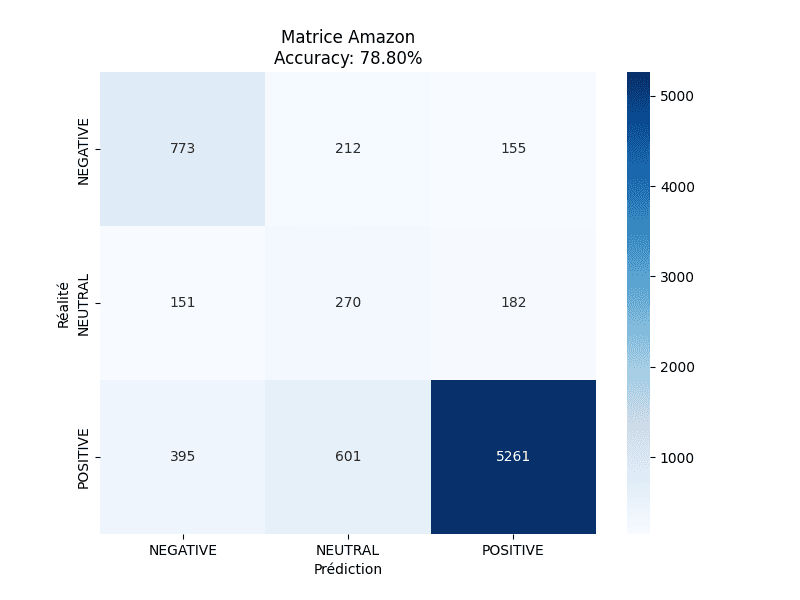
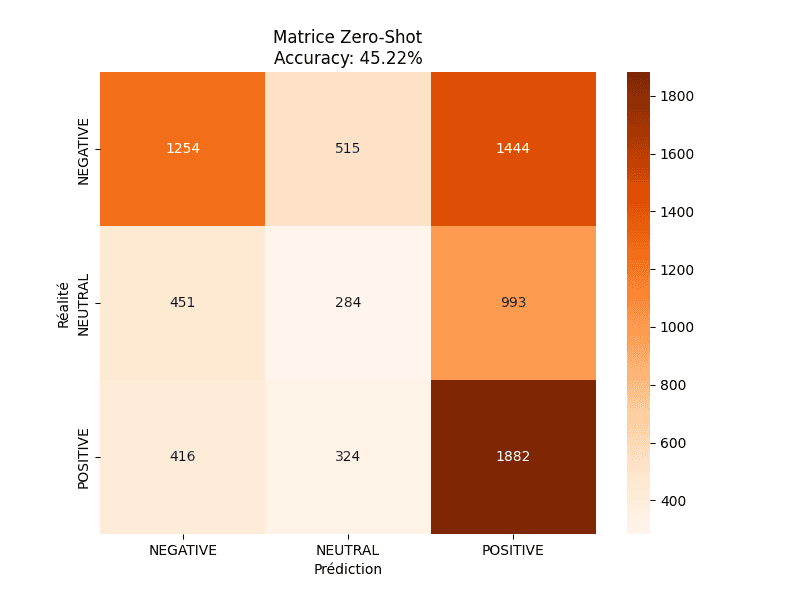
The baseline combines standard NLP preprocessing, unigram/bigram TF-IDF vectorization, and logistic regression across three classes — positive, negative, neutral. Applied without adaptation to the Twitter domain, it loses most of its performance.
- Amazon → Amazon: about 79% accuracy
- Amazon → Twitter (zero-shot, no adaptation): about 45% accuracy
03
Active learning
Rather than annotating the target domain at random, an active learning strategy selects, at each budget step, the tweets deemed most useful to annotate in order to adapt the model.
- Uncertainty — Entropy Sampling, Margin Sampling
- Diversity / representativeness — Diversity (K-Means), Density, Max Distance
- Hybrid — normalized combination of Entropy and Margin
04
Strategy comparison
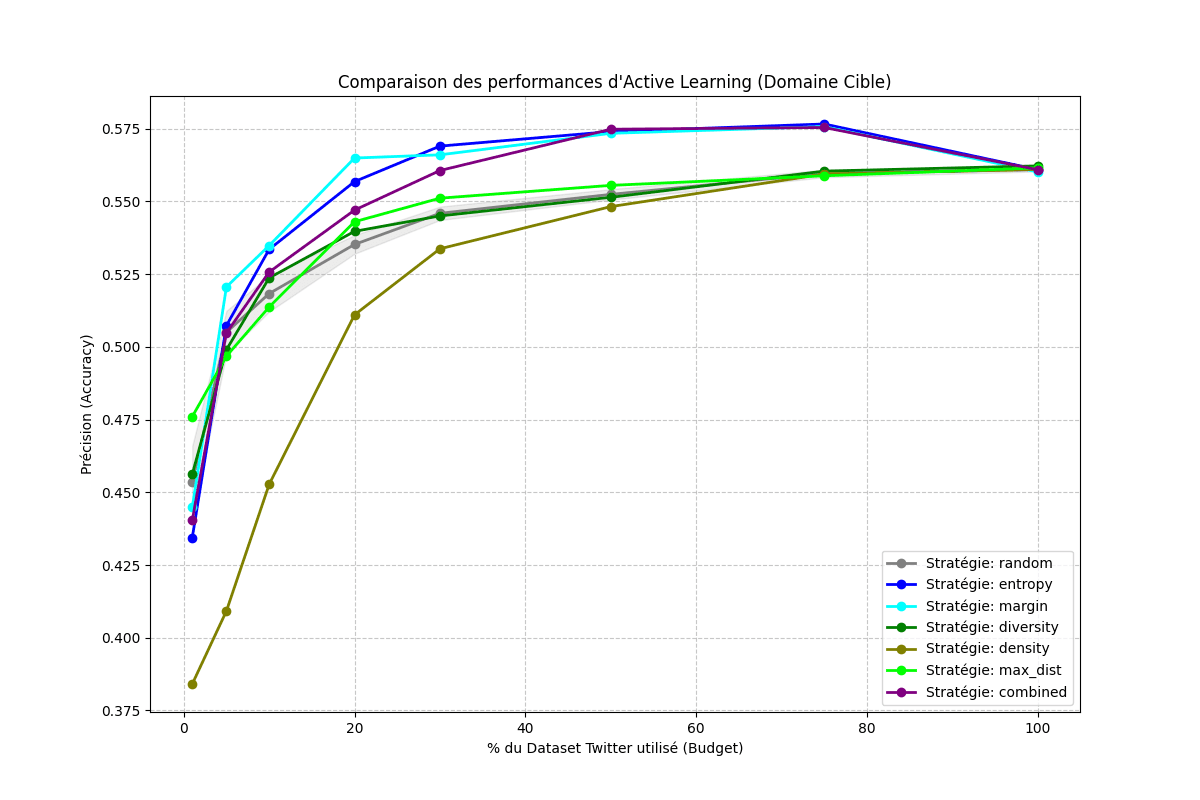
Uncertainty-based strategies are the most effective in the early annotation budgets. Margin and Entropy clearly outperform random selection, while Density is much less suited to this domain. The different strategies gradually converge as the budget increases.
05
Focus on Margin
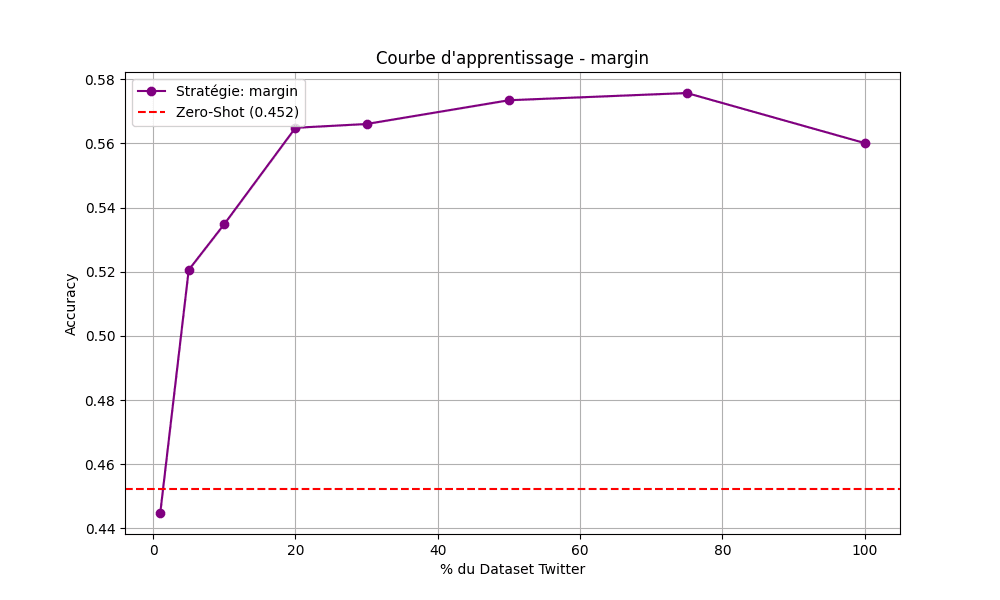
Margin Sampling stands out as the most interesting strategy for the early budgets: performance climbs quickly with few annotated examples, then gradually plateaus. This confirms the value of selecting informative examples rather than annotating at random.
06
Qualitative analysis
The mathematical choice of a strategy concretely changes the nature of the annotated examples. Margin and Entropy favor more ambiguous, information-rich tweets, useful for shifting the decision boundary, while Density tends to select shorter, more redundant messages — which explains its weak performance on this noisy domain.
07
Limits
The TF-IDF representation remains heavily dependent on the vocabulary observed in the source domain. Twitter’s vocabulary differs sharply from Amazon’s, and a significant share of the target domain’s terms stay out-of-vocabulary, which mechanically caps performance. The conclusions remain limited to the datasets and experimental protocol used.